

History
Haltwhistle’s Corn Mills



Earliest Days
The power of the Haltwhistle Burn has been recognised since early times.
The Romans built a watermill on the banks near Hadrian’s Wall at Cawfields. (At this point the burn is actually known as the Pont Gallon). Dated to the 3rd century, the mill was excavated by Gerald Simpson in 1907. Although the wheel was long gone, part of the wheel casing was still in situ. This was a wooden channel formed from three planks which concentrated the flow of water in the mill race onto the lowest paddles of the wheel. From this it was possible to deduce that the wheel was held vertically and was undershot - the water entering at the level of the lowest paddles and turning the wheel by the horizontal impact of the fast flowing water.
It has been calculated that the stream could generate 1.25 horsepower* and that the output from the mill would have produced daily meal for 460 people as well at animal feed. Presumably this would have fulfilled the needs of the troops garrisoned at Great Chesters (Aesica Fort) which lies some 0.8 Kilometres to the East.
Unfortunately, after excavation the remains were recovered with soil and cannot now be traced on the ground.
*Spain 1992 Roman Waterpower: A new look at old problems. Imperial College London Unpublished doctorate
Mulsturs, Sute and Soken
The next evidence of the burn waters being harnessed comes from the household book of William Howard, also known as Belted or Bauld (bold) Will, who purchased the Manor of Haltwhistle in 1611. His records for the following year show the receipt of rent in Hautwysell
………..Rec. of Mr. Harrison for a whole yeare’s rent of the the mill thear, due at martinmas last £5.5s.8d
1620 June . Rec. of John Ridley Miller for one half yeares rent of the Walk Mill at Hautwysley due at Witsunday 1621
In 1632 Lord Howard let the following to Hugh Ridley
“The water Corn Mill with all Mulsturs Tolls, Sute Soken Custome &c to ye same belonging”
These Mediaeval words refer to the rights and duties of the miller.
(Multure: Portion of meal or flour kept by the miller in payment for his services.)
(Suit: The obligation of tenants to resort to a specific mill (usually that of their lord) to have their corn ground)
(Soke: Land attached to a central manor for payment of dues and for judicial purposes.)
Victorian Times
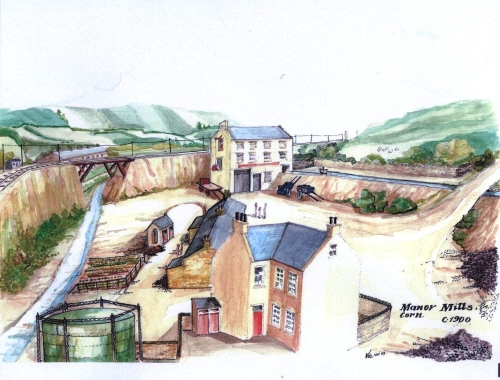
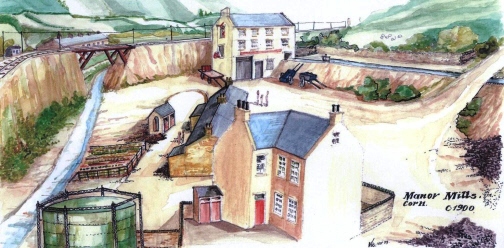
Above: The manor Corn Mill drawn from maps of 1860s by Vic Fleming.
By the early 1800s businesses in Haltwhistle were recorded in Commercial Directories which listed important businesses and people present in each town (those that paid for the entry!) So in 1822 we find Thomas Snowdon – Miller of The Manor Mill. The 1841 census lists Thomas Snowdon, miller aged 60, his wife and three children as living in the mill while the 1848 Whellans Directory gives William Pickering as miller employing two men.
The accommodation at the Mill consisted (in 1856-60 survey) of one two roomed cottage with pantry, coal house, one, one roomed cottage, corn mill with three pairs of stones, a drying kiln, and old kiln (now used for lumber) Water Wheel house, two-stall stable, byer for three cows, six piggeries and garden. The limited living accommodation may account for William’s removal to Main St after the arrival of four children where he is recorded in the 1861 census.
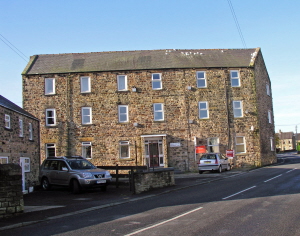
By 1891 a second mill was running in Park Road - this time driven by steam- owned by “John Liddell and sons, grocers, ironmongers, agricultural implement makers and steam corn millers” whilst the two millers, William and his son Edward were living almost next door at New Glenwelt.
Above: Liddell’s Mill today
In the beginning.
Find out about the Geology of Haltwhistle Burn here....
Riches from the earth.
Discover Haltwhistle’s history of brick and pipe making here...
Threads of History.
Unravel the tangled history of the woollen industry of Haltwhistle here...
Seventeen and a Half Candles
Lighting up Haltwhistle- find the story of the gas works here....